
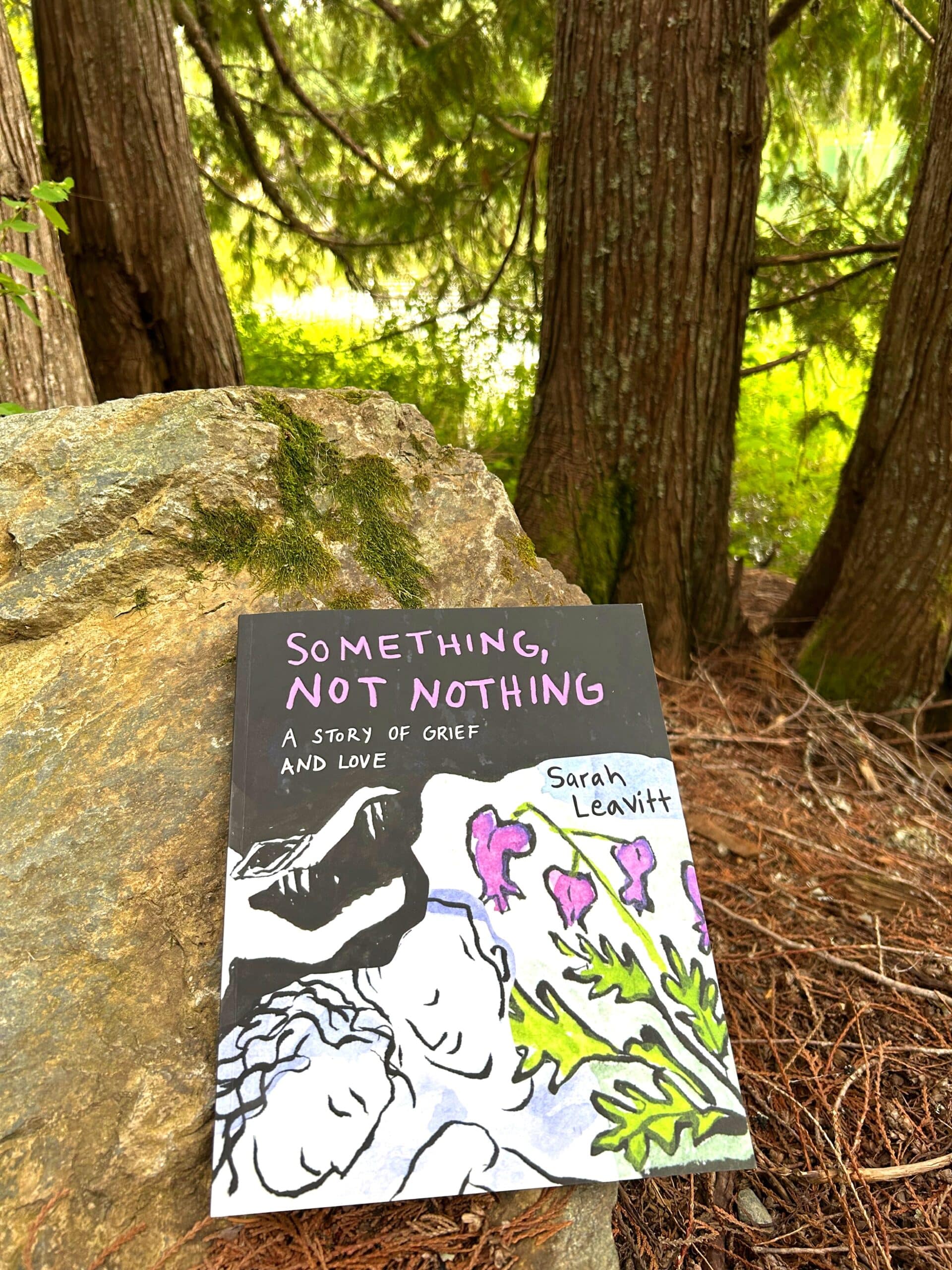
The book explores themes of love and loss, the contrast between “natural” and medically assisted death, the transformative power of art, and the complex, often contradictory emotions that come with grief. Leavitt, who teaches comics at the UBC School of Creative Writing, masterfully communicates these layers through expressive artwork in ink, coloured pencils, and watercolours.
What I appreciated most about the book was Leavitt’s careful choice of imagery and words to express what often feels inexpressible. The narrative is at times both clear and disorienting—reflecting the emotional chaos of her experience. While the book opens in a very dark place, Leavitt gradually finds her way back to love and laughter. Her abstract, often wordless panels invite the reader to interpret them in deeply personal ways. The book is intimate and deeply human. Though grief is unique to each of us, much of what Leavitt shares feels relatable, and I found myself full of empathy for her.
The topic is especially timely. As baby boomers and their families face aging and death, Leavitt’s story reminds us that these conversations are urgent and necessary. There is no escaping death—and sharing our stories helps us process and find meaning.
That said, I found myself missing one element I’ve personally experienced with the death of a loved one. It’s the quiet, guilty sense of relief that can come when someone dies, particularly after prolonged suffering. Perhaps Leavitt didn’t feel this, or perhaps she chose not to include it. Still, it felt like an omission. Donimo’s choice for MAID (Medical Assistance in Dying) was assessed and approved by two separate doctors. I was curious to know more about that process and its emotional impact on Leavitt.
Overall, I recommend this book. It’s honest, human, and deeply affecting. The graphic novel—here, a graphic memoir—is a genre I hadn’t explored before, but now I understand why my grandchildren are so drawn to it. It’s a powerful medium for such a difficult and important subject.
And in the end, I agree with Leavitt: what happens after we die is, indeed, something, not nothing.
Leavitt is an associate professor in the School of Creative Writing at the University of British Columbia, where she has developed and taught undergraduate and graduate comics classes since 2012. She is the author of the graphic memoir Tangles: A Story About Alzheimer’s, My Mother, and Me (2010), and the award-winning historical fiction comic Agnes, Murderess (2019).
Leavitt appears at the Whistler Writers Festival, Oct. 30 to Nov. 2 this year. Program information coming soon.
Review is by Pru Moore.
Pru Moore is an avid reader and writer, and longtime fan of the Whistler Writers Festival. She has retired from a long career as an ICU nurse and a college teacher. Her passions are her friends and family, politics, swimming, and choir.