
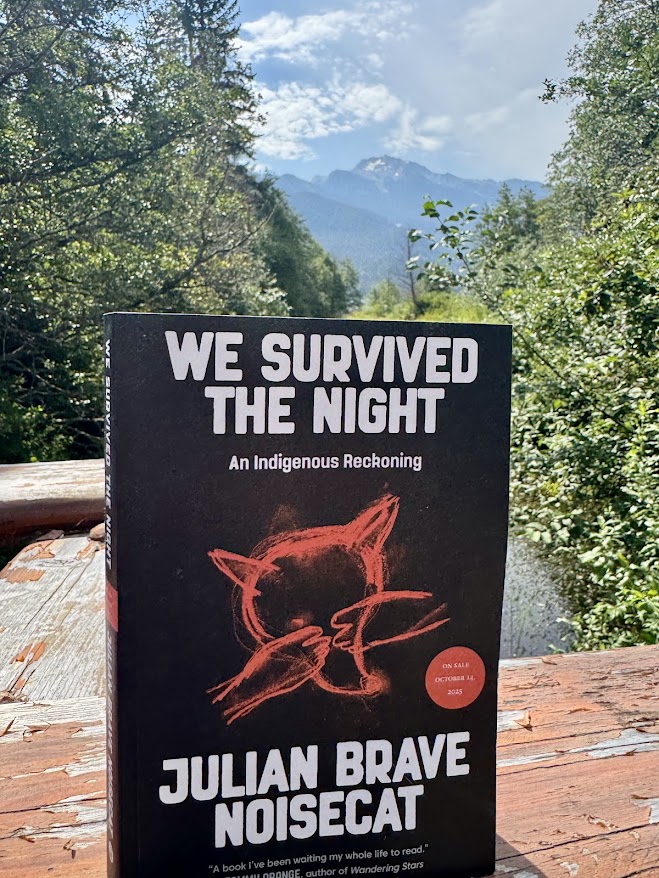
From the get-go, NoiseCat connects the everyday and the supernatural, the silly and the profound. Drawing on stories from his Canim Lake Band Tsq’escen and Lil’wat Nation families, NoiseCat shares the winding tale of his relationship with his father and their interwoven journeys in his powerful first book, We Survived the Night.
While his story is specific and rooted in place, it’s also expansive. It connects the stories of people across Indian Country over decades, critiquing the issues Indigenous Peoples face today, the pervasiveness of the status quo of colonialism and the constant fight for better.
NoiseCat brings you to Nuxalk territory in the Great Bear Rainforest, to Sante Fe art galleries, to dry Arizona and swampy North Carolina and Inuit territory far north. Along the way, the fish, the water, the mountains, the rocks, the ice, are all part of the stories.
The number of characters itself is striking, given how fully-formed they are, portrayed deeply with texture and shadow. At the same time, NoiseCat’s straight-forward voice, with a light wryness and joy for the absurd, makes it easy to follow along with every far-flung journey. He always brings you back to the Coyote tale, drawing connections across rivers and plateaus.
You’ll feel sucked into many vivid worlds. Some well-known faces show up, like the artist Beau Dick, or Simon Fraser, who the Fraser River is named for — a “foolish river pirate,” as NoiseCat describes in detail. There are artists, dancers, politicians, grandmas, papas, aunties, uncles — and, of course, tricksters at every turn.
As NoiseCat points out, a good story often includes some tomfoolery, badassery and trickery. Enigmatic characters and incredible voyages. The book is full of them, including prison breaks, guerilla gunslingers, thieves and mystery. But NoiseCat draws meaning from every story, weaving them together. And suddenly, the story will slow, gentle, to scenes like a young boy wailing because his dad is gone.
He looks at his own pain, intergenerational pain — shared pain — right in the face. Because it’s part of the story. He explores connection and severance, devotion and abandonment, as well as protection, love and fighting like hell against all odds.
The whole time, he weaves in humour among pain — because, as he points out, laughter is a sign you’re still here.
An Oscar-nominated filmmaker and journalist, NoiseCat’s has many pieces of sharp writing — but, as he points out, this book is not journalism, and nor is it memoir. It’s a Coyote story. It’s a type of story-telling that many wanted to see erased.
NoiseCat shows how his people’s stories are full of lessons and meaning, and the very act of holding onto them is an act of survival. He constantly puts the immenseness of that history and survival in perspective. Inuit settled in Greenland, while the Vikings are gone. Empires have fallen while Indigenous governments persist. Changed, inevitably — but persisting.
“We remember these stories because we want to show we really know our kin — so well that we share their stories in all their wonder, horror and complexity,” he writes.
“We tell the truth, as best we know it, about one another. Because these stories and the truths they hold are evidence of our love.”
Beautifully written and transparently researched (the source notes are fascinating on their own), go on and settle in for story time, and find out what happens to Coyote.
Julian Brave Noisecat is a writer and filmmaker. His first documentary, Sugarcane, directed alongside Emily Kassie, premiered at the Sundance Film Festival where it won the Directing Award in the U.S. Documentary Competition. The film was recognized with dozens of awards including Best Documentary from the National Board of Review and was nominated for an Academy Award. A proud member of the Canim Lake Band Tsq’escen and descendant of the Líl̓wat Nation of Mount Currie, NoiseCat’s first book, We Survived the Night, is out Oct. 14.
Review is by Steph Kwetásel’wet Wood, who is Sḵwx̱ú7mesh writer who works at The Narwhal, an online magazine that reports on the natural world. She contributed to the Sḵwx̱ú7mesh history book tiná7 cht ti temíxw: We Come From This Land.
NoiseCat appears at the Whistler Writers Festival in READING EVENT 5: We Survived the Night: In Conversation with Julian Brave NoiseCat and moderated by author, Jonina Kirton. The event is at the Squamish Lil’wat Cultural Centre.
This review first appeared in the Whistler Pique Newsmagazine.